PART 2: CONFECTIONERY COMPETENCIES
Creating confections takes a different skill set from baking or cooking. Understanding how to cook confections well comes down to three main elements.
- Chemistry
- Tools
- Measurement
1. CHEMISTRY
At its heart, understanding candy making is about understanding the chemistry of sugar crystallization.
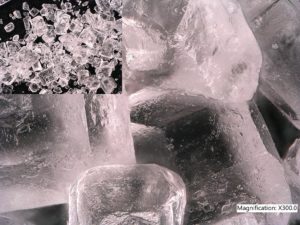
Most candy begins with granulated sugar, or sugar crystals. Less sugar crystals can be dissolved in cold water than in hot. So, we boil sugar and water (and sometimes other ingredients) to create a simple solution with a higher amount of sugar dissolved within. This creates a sweeter and more cohesive candy.
If we allow a sugar solution to cook to a high heat the water will boil off, creating what is called a super-solution. If a sugar solution reaches super-solution stage, re-crystallization will occur. If you have ever bitten into a caramel and felt a grainy crunch , that is what happened.
The addition of certain substances – butter or cream, for example – will inhibit re-crystallization, which helps to maintain a cohesive chemicalf solution.
In this recipe for peanut brittle, we are always aiming to maintain a cohesive solution.
2. TOOLS
Making Candy, in our case making nut brittles, takes specialized tools. Most important are:
- A Candy Thermometer
- A Heavy-bottomed Pot
- Measuring Cups
- Off-set Wooden/Bamboo Spoon
- Light-weight cookie sheets
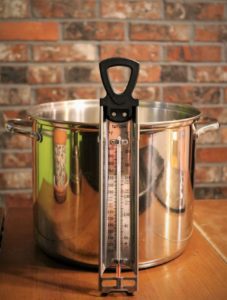
A candy thermometer like the one shown above is best. You can read it easily, and each candy stage from soft ball to hard crack is marked clearly. If you look closely, you can see that the thermometer itself doesn’t touch the bottom of the pan. The metal surround protects from the inaccuracy of the thermometer itself touching the bottom of the pan.
A heavy-bottomed pot is essential for even heat distribution. This prevents cold and hot spots, and irregular cooking of your sugar solutions.
I prefer nesting measuring cups like the one in the photo below in the corn syrup picture. It is easier to control the exact measurement of solids and liquids because the top of the measuring cup is just that – the top.
A wooden spoon is a must in making candy. Very few tools can stand up to boiling sugar solutions at 300 degrees without degrading. Wooden spoons are absolutely up to the task. I personally prefer an off-set tipped bamboo spoon like in the photo below. The off-set tip reaches into the edges of the pot to dislodge peanuts that a rounded edge might miss. Bamboo is also very strong, and very sturdy, withstanding repeated uses well.
Light-weight cookie sheets are fantastic for sheet candies – candy that is poured into a sheet to cool before breaking into bite-sized pieces. If you use a light-weight cookie sheet you will be able to twist the pan and pop the sheet of brittle off to break it easily.
3. MEASUREMENT
Correct measurement practices are incredibly important in chemistry. The measurement skills you might learn in a high school chemistry class apply ably to creating confections.
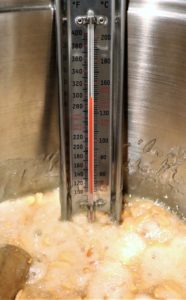
When using your candy thermometer, you must look for the meniscus. As you can see in the picture below, the red line shows the temperature, but you are looking for the very middle of the red line to be certain of reaching the correct level. This includes getting as close to level as you can with your thermometer, and closely observing where the bottom of the meniscus is. This tells you the true temperature.
Candy is very easily ruined by mismeasuring temperature. Too cold, and your brittle will be soft. Too hot, and it will be bumpy and bubbly, lose its shine, and resemble sea foam candy instead of brittle. Always aim for the middle!